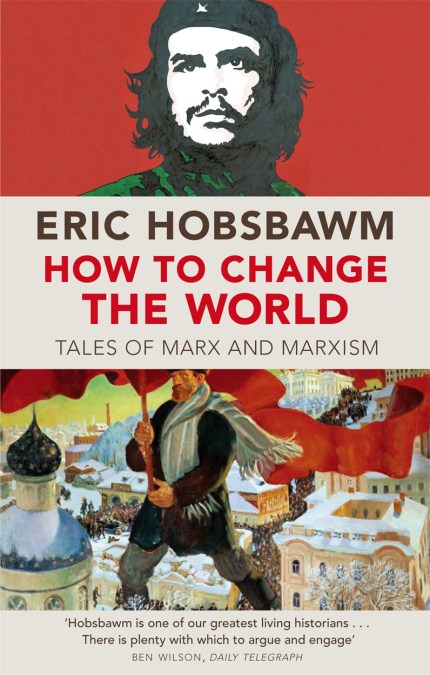
Eric Hobsbawm - How To Change The World - Little, Brown Book Group
Available Formats
  • E-Book £P.O.R.
    More information
    • ISBN:9780748121120
    • Publication date:20 Jan 2011

How To Change The World

By Eric Hobsbawm

  • Paperback
  • £12.99

* Brilliant and incisive, HOW TO CHANGE THE WORLD leaves us in no doubt that Karl Marx is as much a thinker for our century as he was for the preceding two

In the 144 years since Karl Marx's Das Kapital was published, the doctrine that bears his name has been embraced by millions in the name of equality, and just as dramatically has fallen from grace with the retreat of communism from the western world. But as the free market reaches its extreme limits in the economic and environmental fallout, a reassessment of capitalism's most vigorous and eloquent enemy has never been more timely.

Eric Hobsbawm provides a fascinating and insightful overview of Marxism. He investigates its influences and analyses the spectacular reversal of Marxism's fortunes over the past thirty years.

  • Other details

  • ISBN: 9780349123523
  • Publication date: 19 Jan 2012
  • Page count: 480
Biographical Notes

Eric Hobsbawm was born in Alexandria in 1917 and educated in Vienna, Berlin, London and Cambridge. A distinguished historian, he is a Fellow of the British Academy and of the American Academy of Arts & Sciences, with honorary degrees from universities in several countries.

Little, Brown

Fractured Times

Eric Hobsbawm

Born at the turn of the 20th century and raised in Vienna, Eric Hobsbawm, who was to become one of the most brilliant and original historians of our age, was uniquely placed to observe an era of titanic social and artistic change. As the century progressed the forces of Communism and Dadaism, Ibiza and cyberspace, would do battle with the bourgeois high culture fin-de-si?cle Vienna represented - the opera, the Burgtheater, the museums of art and science, City Hall. In Fractured Times Hobsbawm unpicks a century of cultural fragmentation and dissolution with characteristic verve and vigour.Hobsbawm examines the conditions that created the great cultural flowering of the belle ?poque and held the seeds of its disintegration, from paternalistic capitalism to globalisation and the arrival of a mass consumer society. Passionate but never sentimental, Hobsbawm ranges freely across his subject: he records the passing of the golden age of the 'free intellectual' and examines the lives of great, forgotten men; he analyses the relation between art and totalitarianism and dissects cultural phenomena as diverse as surrealism, women's emancipation and the American cowboy myth. Written with consummate imagination and skill, Fractured Times is the last book from one of our greatest modern-day thinkers.

Abacus

Revolutionaries

Eric Hobsbawm

Recent years have seen a remarkable growth of interest in revolution and social upheaval. This collection of essays by distinguished historian and long-standing Marxist Eric Hobsbawm is a commentary and critical retrospective on the revolutionary movements and ideas that dominated the twentieth century, and which remain of crucial contemporary relevance. The essays here explore a broad range of related topics including the history of communism, the influence of marxism, insurrection, military coups and guerrilla warfare, and the role of intellectuals. This updated edition presents new thoughts on anti-communist polemics and the Spanish Civil War.Written with clarity and masterly assurance, Eric Hobsbawm's essays are indispensable for a true understanding both of twentieth-century history and of the pattern of events today.

Abacus

Globalisation, Democracy And Terrorism

Eric Hobsbawm
Abacus

Uncommon People

Eric Hobsbawm

This collection of 26 essays range over the history of working men and women between the late 18th century and the present day, and brings back into print a selection of this celebrated historian's pioneering studies into labour history, together with more recent reflections previously unpublished in book form.Eric Hobsbawm's penetrating essays on labour history and social protest opened up a new field of study and set standards of wide-ranging, evocative, incisive analysis. Essays in this collection include the formation of the British working class; labour custom and traditions; the political radicalism of 19th century shoemakers; male and female images in revolutionary movements; revolution and sex; peasants and politics; and the common-sense of Tom Paine. More recent essays include meditations on the May Day holiday; the Vietnam War; socialism and the avantgarde; Mario Puzo, the Mafia and the Sicilian bandit Salvatore Giuliano; and the cultural consequences of Christopher Columbus. Throughout these essays runs a passionate concern for the lives and struggles of ordinary men and women - uncommon people, all of them.

Abacus

On History

Eric Hobsbawm
Abacus

Bandits

Eric Hobsbawm

BANDITS is a study of the social bandit or bandit-rebel - robbers and outlaws who are not regarded by public opinion as simple criminals, but rather as champions of social justice, as avengers or as primitive resistance fighters. Whether Balkan haiduks, Indian dacoits or Brazilian congaceiros, their spectacular exploits have been celebrated and preserved in story and myth. Some are only know to their fellow countrymen; others like Rob Roy, Robin Hood and Jesse James are famous throughout the world. First published in 1969, Bandits inspired a new field of historical study: bandit history. This substantially extended and revised new edition appears at a time when the disintegration of state power has reintroduced fertile conditions for banditry once again to flourish in many parts of the world.

Abacus

The Age Of Revolution

Julian Rathbone, Eric Hobsbawm
Abacus

The New Century

Eric Hobsbawm

Eric Hobsbawm's AGE OF EXTREMES was a remarkable phenomenon, a book of serious and challenging historical analysis that became a worldwide bestseller. Now, THE NEW CENTURY continues Hobsbawm's analysis of our twentieth century, asking crucial questions about our inheritance from the century of conflict and its meanings for the years to come. Looking back over the last decade to learn something of the new era, Hobsbawm finds the distinction between internal and international conflicts and between state of war and state of peace disappearing. He goes on to analyse the crisis of the multi-ethnic state and shows the distortions of history involved in the creation of its myths. He expresses his anxiety over the system of international relations between states that have so far ruled by colonialism and nuclear terror. Hobsbawm then assesses the impact that a popular global culture has had on every aspect of life, from happiness and social hierarchy to nutrition and the environment. Published this year in dozens of countries throughout the world, THE NEW CENTURY is a concise summary of the thinking of one of the pre-eminent historians.

Abacus

Interesting Times

Eric Hobsbawm
Abacus

The Age Of Capital

Eric Hobsbawm

The first and best, major treatment of the crucial years 1848-1875, a penetrating analysis of the rise of capitalism throught the world.In the 1860s a new word entered the economic and political vocabulary of the world: 'capitalism'. The global triumph of capitalism is the major theme of history in the decades after 1848. It was the triumph of a society which believed that economic growth rests on competitive private enterprise, on success in buying everything in the cheapest market (including labour) and selling it in the dearest. An economy so based, and therefore nestling naturally on the sound foundations of a bourgoisie composed of those whom energy, merit and intelligence had raised to their position and kept there, would - it was believed - not only create a world of suitably distributed material plenty but of ever-growing enlightenment, reason and human opportunity, an advance of the sciences and the arts, in brief a world of continuous and accelerating material and moral progress.

Abacus

The Age Of Empire

Eric Hobsbawm

The splendid finale to Eric Hobsbawm's study of the nineteenth century, THE AGE OF EMPIRE covers the area of Western Imperialism and examines the forces that swept the world to the outbreak of World War One- and shaped modern society.

Piatkus

Keeping Your Head After Losing Your Job

Robert L. Leahy
Abacus

Sale Of The Century

Chrystia Freeland

This is the first account of Russia's second revolution - the country's dramatic, wrenching transition from communist central planning to a market economy. Written by one of the finest writers on contemporary Russia, it is told by interweaving high politics with glimpses of the revolution's impact on the lives of ordinary people.Beginning with a sharp portrayal of the dismal living conditions in the Soviet Union, she moves on to the romantic early days of the capitalist transformation. This was the height of market euphoria when, despite the chaos of everyday life, a prosperous future seemed within easy reach. Woven through the book are remarkable stories - of Yeltsin's use of popular psychics, of the might of the 'robber barons' who form alliances with criminal mafia gangs, of Machiavellian politicians who 'have dealt with the devil and believe they have made a good bargain'. In the final stage of the book, Freeland chronicles the end of the first wave of Russia's capitalist revolution, detailing the economic crisis currently rumbling through the country.

Sphere

The Search For Peace

Douglas Hurd

We live in a world of nation states, immortal and political entities that act as a focus for the loyalty of the citizen but cannot by themselves meet those citizens' needs. As the history of our own continent illustrates, a Europe of nation states has bred a Europe of endemic warfare. Such has been the problem facing international diplomacy for nearly two hundred years. Douglas Hurd traces the search for peace back to the Treaty of Vienna in 1815, focusing his attention on four key events - the Congress of Vienna, the Treaty of Versailles in 1919, the Yalta settlement of 1945 and the collapse of Communism. He demonstrates how the diplomatic realism that kept Europe at peace for a century was destroyed by both American idealism at the end of the First World War and the accompanying rise of Nazism, Fascism and Marxism. Only by appreciating the lessons of the past, can we meet the new challenges presented by the tumultuous events of 1989, when the threat of nuclear war was replaced by the open wound of Bosnia. Combining acute historical analysis with the unique insight of a former Foreign Secretary, THE SEARCH FOR PEACE is a major contribution to our understanding of international politics.

One of the leading historians of the 20th century

Eric Hobsbawm: 1917 - 2012

We were saddened to learn of the passing away of Eric Hobsbawm, one of the leading historians of the 20th century, earlier today at the age of 95.

Abacus

The Forsaken

Tim Tzouliadis
Abacus

Earth Odyssey

Mark Hertsgaard
Little, Brown

The Age Of The Unthinkable

Joshua Ramo
'Great stories, wonderfully told'

Little, Brown

Little, Brown is the literary hardback imprint that feeds into Abacus paperback. We publish across a wide range of areas, including fiction, history, memoir, science and travel, but within this diverse list the vast majority of books have in common a strong narrative and a distinctive voice. In 2012 Little, Brown/Abacus have published 8 Sunday Times bestsellers to date.

Abacus

Immigrants

Philippe Legrain